
Bet the baby. Mom takes the rake.
A friend-and-family parimutuel pool on your baby’s arrival. Pick what the baby will do, lay a wager, watch the odds shift as the rest of the group chat puts money down. When the kid arrives, the pot pays out and Mom takes her cut.
The lifecycle
Five steps from join code to payout
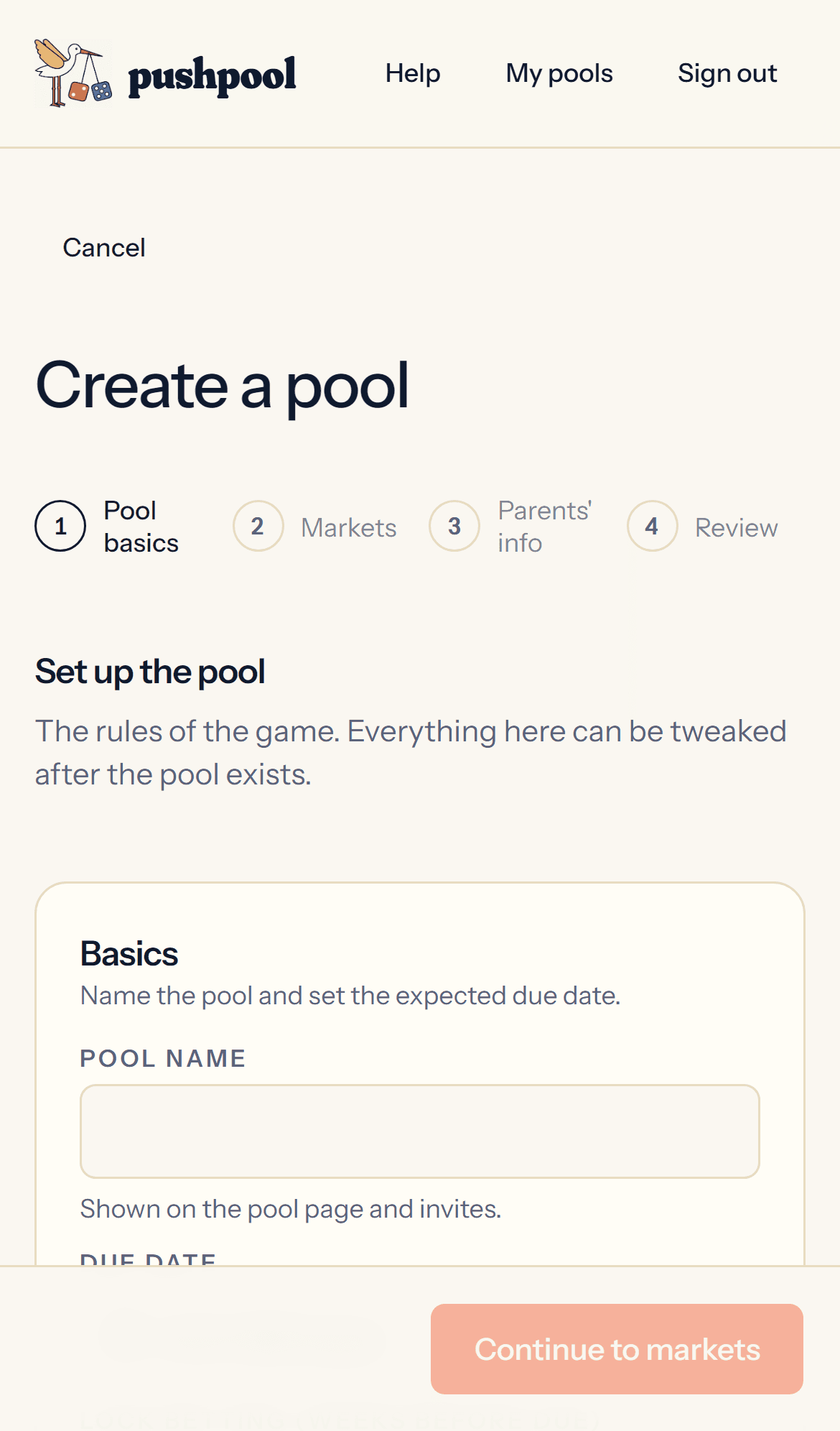
- 1Host
Open the books
The host (often Mom, sometimes a sibling or friend) names the pool, picks the due date, and chooses what’s bettable — gender, weight, time of day, hair color, labor length, whatever fits. Seed each outcome with your best guess; that prior anchors the odds until bets start landing.
- 2Share
Drop the link in the group chat
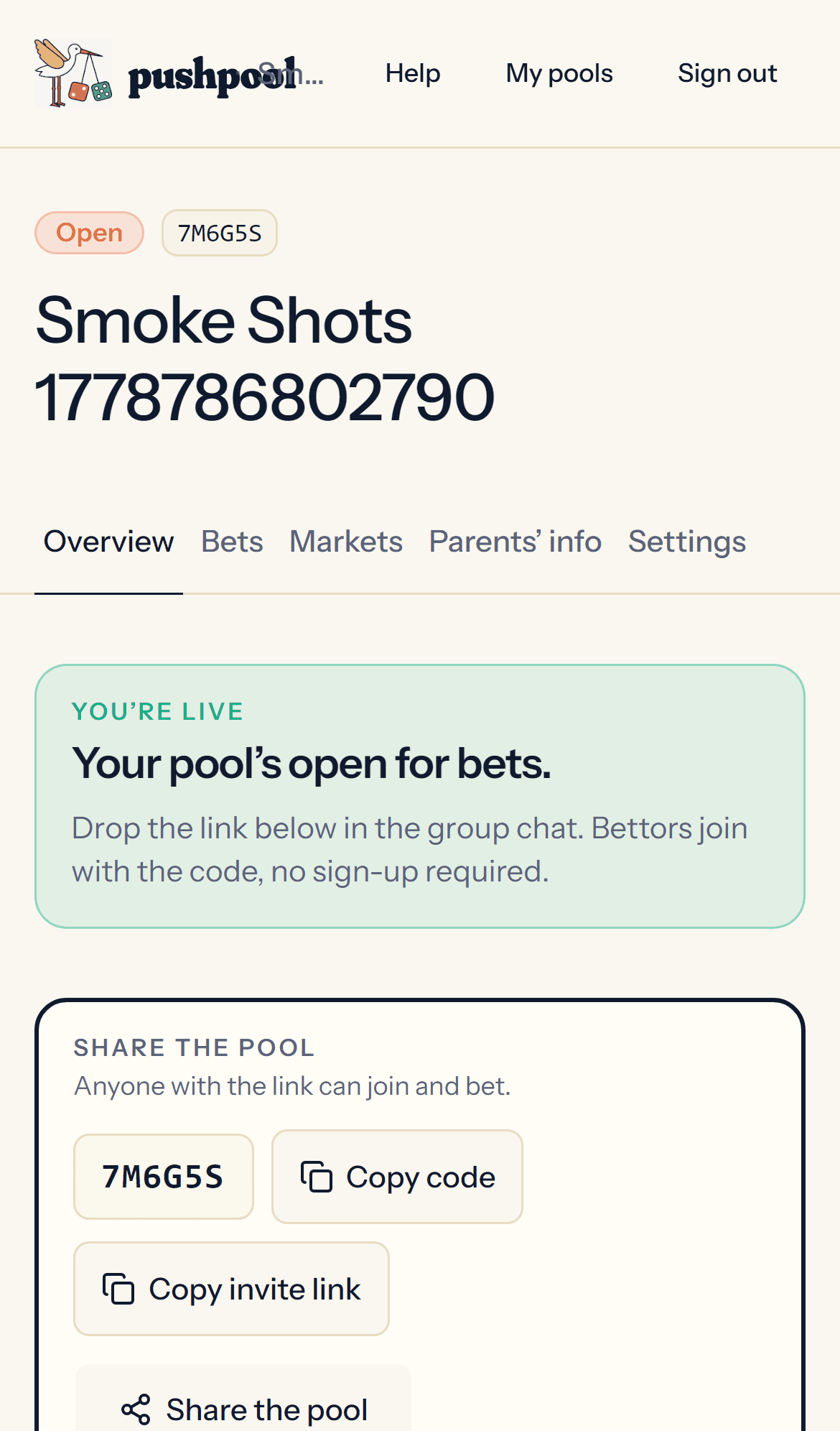
Every pool gets a six-character join code and a share-anywhere link. Send it to family, friends, the bridge club. No accounts needed for guests — they enter a name and they’re in.
- 3Wager
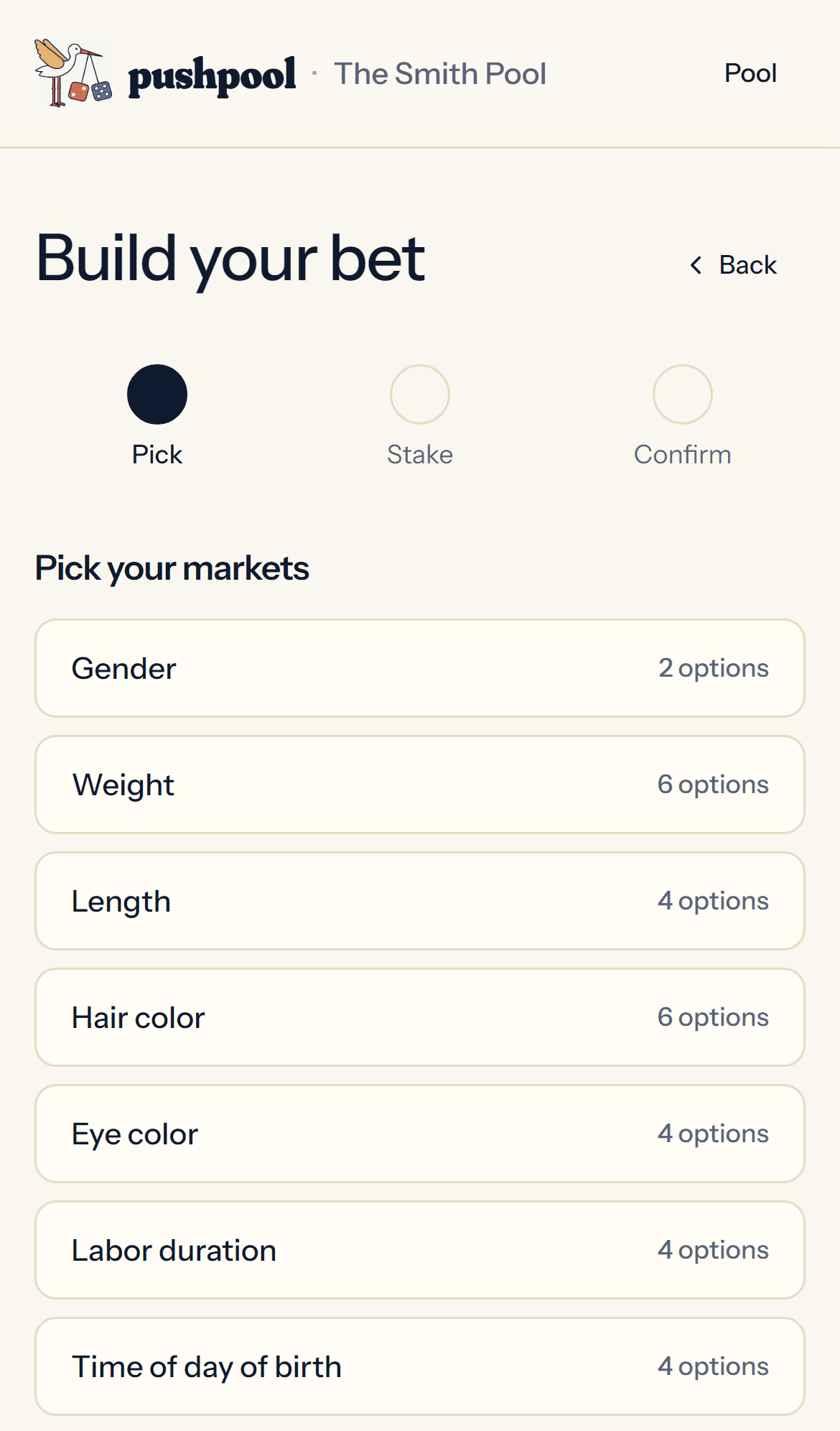
Lay your wager, build a parlay if you’re feeling it
Pick an outcome, set your stake, and see your projected payout before you commit. Parlay across markets if you want a bigger swing — “girl AND over 8 lbs AND born before noon.” Odds shift live as new bets land.
Pay the host directly via Venmo, Cash App, or whatever you normally do. PushPool never touches the money.
- 4Close
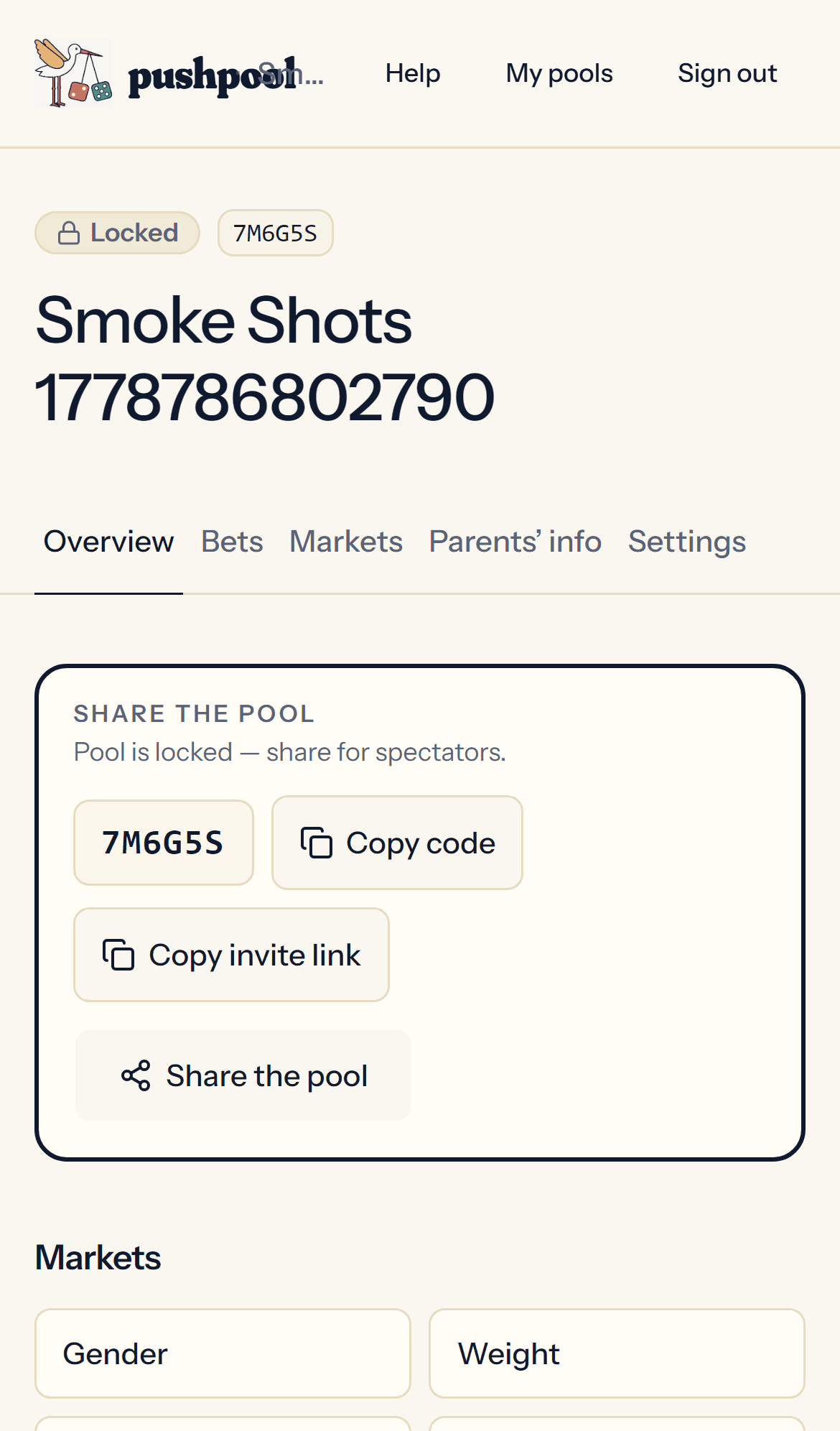
Betting closes, odds freeze
The host sets a close window — usually a few weeks before the due date so late-pregnancy ultrasounds don’t hand inside info to nearby family. After close, the odds lock in and no new bets land.
- 5Settle
The baby arrives, the pot pays out
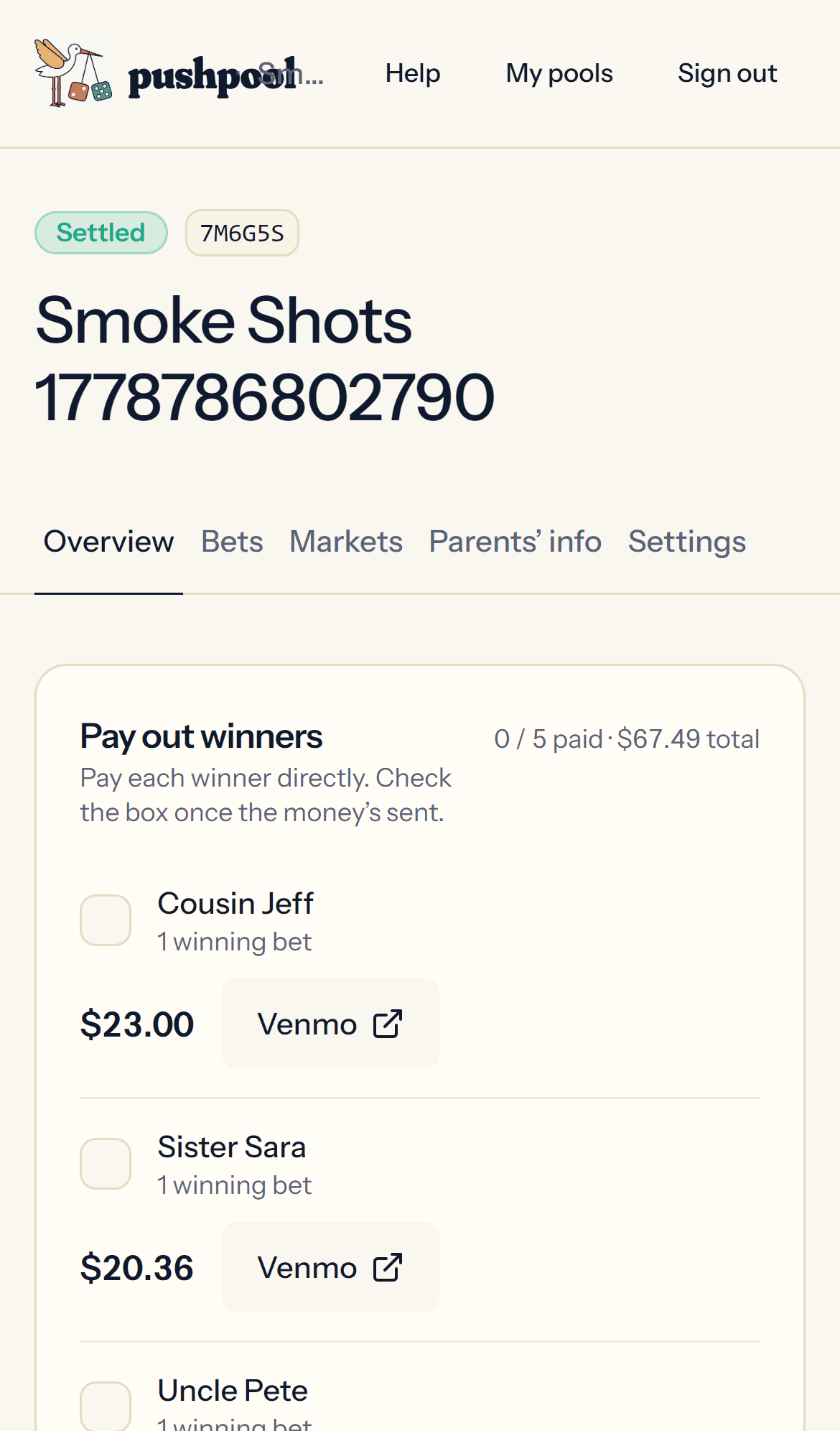
The host enters the actual outcomes — gender, weight, time of day. The math runs, payouts compute, winners get receipts. The host pays them out the same way bets came in.
The pool stays open afterward. Drop in baby photos, react to bets, talk smack about the parlay that should have hit.
House math
How the math works
A capped parimutuel pool with a host-set prior. The host’s prior dominates early; the crowd’s signal asserts itself as more bets land. Mom takes a configurable rake off the top. The pot is capped— winners can never collectively be paid more than what’s in it, so the host carries zero variance risk.
Let’s walk through a 10% rake pool with $200 in the pot.
- 1.
Live odds (per outcome)
Host opened “Gender” at 50/50. So far $120 is staked on Boy, $80 on Girl.
Live probability = stake on outcome ÷ stake in market
- Live(Boy) = 120 ÷ 200 = 60%
- Live(Girl) = 80 ÷ 200 = 40%
- 2.
Blended final odds
Default weights: 70% host prior, 30% crowd signal.
- Final(Boy) = 0.7 × 0.50 + 0.3 × 0.60 = 53%
- Final(Girl) = 0.7 × 0.50 + 0.3 × 0.40 = 47%
- 3.
Your single-leg bet
You stake $10 on Girl.
Payout if Girl wins = stake ÷ final probability × (1 − rake)
= 10 ÷ 0.47 × 0.90 = $19.15
That’s $9.15 of profit after Mom’s cut.
- 4.
Your parlay
You parlay Girl with “Weight ≤ 7 lbs” (host prior 40%, no crowd bets there yet).
- Final(weight) = 0.7 × 0.40 + 0.3 × 0.00 = 28%
- Parlay probability = 0.47 × 0.28 = 13.2%
- Payout if both hit = 10 ÷ 0.132 × 0.90 = $68.39
- 5.
The cap
After settlement, all winning payouts are summed. If the total exceeds the pot minus rake ($200 × 0.90 = $180), every winner is scaled down proportionally so the math closes.
Example: computed payouts total $300. Scale factor = 180 ÷ 300 = 0.60. Your parlay pays $68.39 × 0.60 = $41.03 instead of $68.39.
If computed payouts are under the cap, winners get their full computed payout and the remainder stays with Mom.
Mom’s take
Pot × rake. In this example, $200 × 10% = $20 — plus any unallocated remainder when computed payouts come in under the cap.
PushPool never takes a cut. Every dollar of rake is Mom’s.